2 July 2026
Reviewed 2 August 2026
What does curtain fabric weight in gsm change about drape and light blocking?
Updated:
Fabric weight in grams per square metre predicts most of a curtain's behaviour: fold depth, daylight blocked, track load in kilograms and how the hem sits on the floor. Suppliers print the gsm figure on every sample tag, and buyers rarely read the figure.
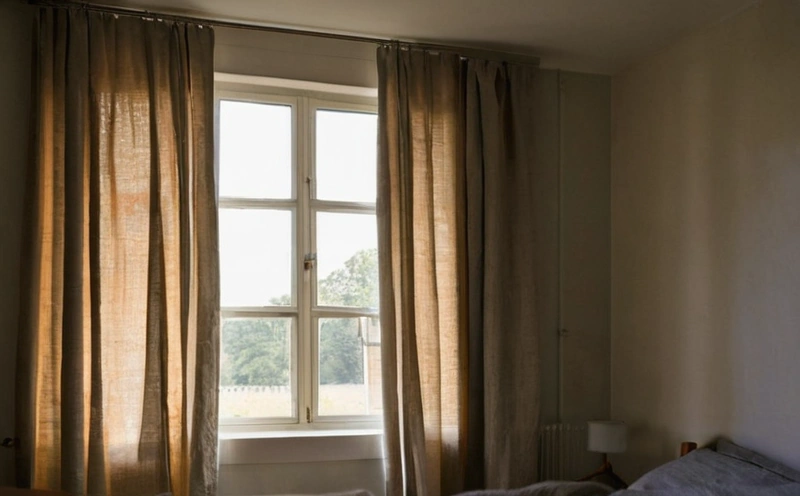
Which curtain fabric weight band does each gsm figure fall into?
Curtain fabric weight starts at 40 gsm for polyester voile and passes 450 gsm for interlined velvet, and the gsm figure predicts fold depth, light blocking and track load. A 70 gsm voile forms shallow folds that lift in moving air. A 380 gsm wool blend holds fold depth down the whole 2.8 metre drop.
| Weight band | Typical fabrics | Fold behaviour | Daylight stopped, unlined, mid tone | Fullness ratio to track length |
|---|---|---|---|---|
| 40 to 70 gsm | Polyester voile, sheer linen, cotton lawn | Shallow soft folds that lift when the air conditioning starts | 20 to 30 percent | 2.5 to 3.0 times |
| 120 to 170 gsm | Light cotton, cotton linen blends | Narrow folds, needs a hem weight to hang straight | 40 to 55 percent | 2.5 times |
| 180 to 260 gsm | Medium linen, cotton canvas, printed furnishing cloth | Regular folds held down the full drop | 55 to 80 percent | 2.0 to 2.5 times |
| 280 to 420 gsm | Wool blends, chenille, heavy jacquard | Deep folds that keep their shape when the pair is open | 85 to 92 percent | 2.0 times |
| 450 gsm and above | Velvet, interlined pairs | Wide sculpted folds and a stack that covers part of the window | 90 to 95 percent | 2.0 times |
Fullness ratio corrects for weight. A cloth under 120 gsm hung at only 2.0 times the track length hangs flat and reads mean, while a cloth above 300 gsm hung at 2.5 times produces a stack so bulky that the open pair covers roughly a third of the window opening. Match the ratio to the band before ordering the fabric quantity.
How does curtain fabric weight change drape and fold count?
Weight supplies the downward force that pulls a curtain fold straight, and stiffness resists that force, so a 300 gsm cotton canvas forms few wide flat faced folds while a 190 gsm washed linen forms many narrow folds. Viscose and wool drape softly at any gsm figure, while cotton and polyester hold more structure.
Fibre changes the outcome as much as the gsm figure does. A 240 gsm viscose blend and a 240 gsm cotton canvas weigh the same on the scale and hang in different shapes: the viscose blend falls into rounded folds that move, the cotton canvas holds flat faces and sharp fold edges. Ask the supplier for the drape coefficient if the fabric is unfamiliar, or hold a metre of cloth from one hand and watch how many folds form on their own.
Weave structure supplies the third variable. A satin weave floats long yarns across the surface, which lowers yarn to yarn friction and increases fold count at any given weight, while a plain weave locks every crossing and resists folding. Two linens at 220 gsm, one plain woven and one in a satin weave, produce visibly different fold counts on the same track.
How much daylight does each curtain weight stop without a lining?
An unlined mid tone curtain at 70 gsm stops 20 to 30 percent of direct daylight, at 160 gsm stops 50 to 60 percent, at 240 gsm stops 65 to 80 percent, and at 380 gsm stops 85 to 92 percent. No unlined curtain fabric reaches full darkness, because daylight passes through the gaps between yarns.
Colour shifts every one of those figures. A dark 240 gsm linen blocks noticeably more daylight than a cream 240 gsm linen of identical construction, because the dark dye absorbs the light that the pale cloth scatters forward into the room. Weave density counts too: a tightly sett 200 gsm cloth can outperform a loosely sett 260 gsm cloth.
Ultraviolet exposure decides how long the colour lasts. Curtain fabric for a sun facing window needs a light fastness of at least 5 on the blue wool scale of BS EN ISO 105-B02, where the scale runs 1 to 8 and each step roughly doubles the exposure needed for the same visible fade. A cloth rated 3 facing south will show a pale leading edge inside two years.
Which curtain lining should be specified for each requirement?
Cotton sateen lining at 130 to 160 gsm protects the face fabric from ultraviolet fading and adds 15 percent light blocking. Thermal lining at 200 to 260 gsm carries an acrylic foam coat and stops 90 percent of daylight. Blackout lining at 250 to 300 gsm blocks all light through the panel.
| Lining | Weight | Construction | Daylight blocked behind a 240 gsm face fabric | Main function |
|---|---|---|---|---|
| Cotton sateen | 130 to 160 gsm | Woven cotton, no coating | About 80 percent | Shields the face fabric from ultraviolet fading and adds a little body |
| Thermal | 200 to 260 gsm | One acrylic foam coat on a cotton base | 90 percent and above | Cuts heat transfer through the glazing |
| Blackout | 250 to 300 gsm | Three acrylic foam passes on a woven base | Effectively 100 percent | Removes light through the panel, leaving only perimeter leaks |
| Interlining, also called bump | 180 to 220 gsm | Soft brushed fleece sewn between face and lining | 85 to 90 percent | Rounds the folds and gives a modest cloth the drape of a heavy one |
Blackout lining removes light through the cloth and does nothing about the perimeter. A blackout pair on a face fixed track still leaks daylight down both side edges and over the top unless the track returns to the wall, so a bedroom that needs real darkness needs a wall returned track or a side channel, not a heavier lining.
How much does a curtain panel weigh, and what track does the weight need?
A 240 gsm fabric panel measuring 1.6 metres wide by 2.8 metres long covers 4.48 square metres and weighs about 1.1 kilograms. A 150 gsm cotton lining adds 0.67 kilograms, bringing the panel to 1.7 kilograms. A pair of interlined velvet panels at the same size passes 6 kilograms.
Total weight rules out hardware. Adhesive mounted and tension rod fittings are commonly rated for 2 to 4 kilograms across the whole span, which a lined medium weight pair already exceeds, so an interlined velvet pair at 6 kilograms and above needs a screw fixed track into masonry or into a timber batten.
Heading style follows total weight. Pinch pleats need a firm buckram heading and suit totals above 350 gsm face plus lining. Wave headings suit totals between 200 and 400 gsm. Eyelets work at almost any weight but produce a shallow fold that flatters heavy cloth and exposes light cloth as a flat sheet.
Hem weights, small lead squares of 20 to 40 grams sewn into the bottom corners, keep a light panel hanging straight. Skip the weights on any cloth under 150 gsm and the hem lifts every time the air conditioning starts.
How much does linen curtain fabric shrink, and what does shrinkage do to a lined pair?
A washed linen curtain face at 220 gsm shrinks 3 to 5 percent on a first wash, while a coated blackout lining shrinks close to zero. A lined pair washed as one piece can therefore develop a puckered hem. Dry clean lined curtains, or wash both cloths separately before making up the pair. Practical guidance on removing stains from pale linen addresses another common linen care task.
The arithmetic is worth doing before the cloth is cut. A 5 percent shrinkage on a 2.8 metre drop removes 140 millimetres, which turns a curtain that broke on the floor into one hanging above the skirting. Add the shrinkage allowance to the cut length, or specify a pre shrunk linen and accept the higher metre price.
Cotton sateen lining shrinks 2 to 3 percent on a first wash, close enough to a linen face that a washed pair often recovers with pressing. A coated thermal or blackout lining shrinks under 1 percent, and the mismatch against a linen face is what produces the ripple down the leading edge. Spot treatment on a linen panel follows the sequence in the note on fresh spills on pale linen.