21 July 2026
Reviewed 2 August 2026
How do you remove a fresh stain from pale linen without leaving a ring?
Flax gains roughly 20 percent in tensile strength when wet, so pale linen tolerates immediate treatment better than cotton or wool. The lasting damage on linen almost always comes from the hands, not from the spill.
What should you do in the first sixty seconds after a spill on pale linen?
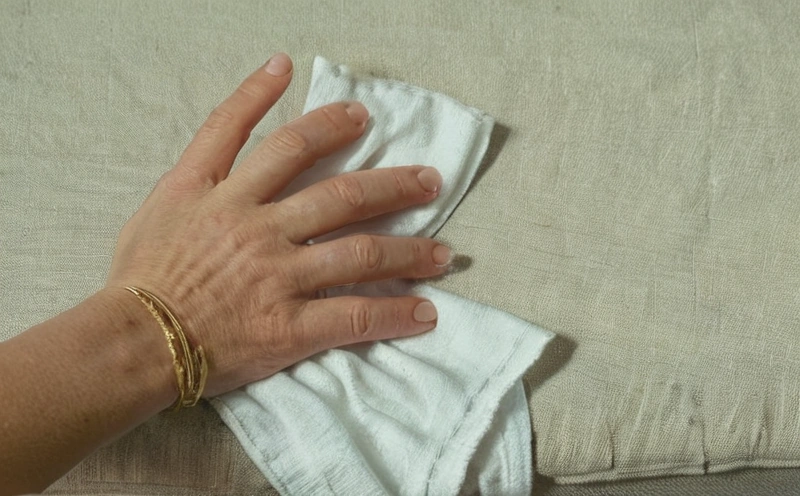
Lift solids from pale linen with the flat of a blunt knife, slide a folded white cotton towel under the cloth, then press a second white cloth onto the mark for 5 seconds and lift straight up. Repeat on a clean section of cloth for 6 or 7 presses, roughly 1 minute of blotting in total.
Add cold water at 15 to 20 degrees Celsius next, sprayed rather than poured, at roughly 2 millilitres per application. Cold water alone lifts most of a fresh spill of red wine, tea, fruit juice or blood from linen within the first minute, before the colouring matter has bonded to the cellulose.
Hot water is the standard mistake on linen. Protein stains, milk, egg, blood and gravy among them, coagulate above 40 degrees Celsius and bond to the flax permanently, which turns a five minute job into a permanent shadow. Work from the outside of the mark inward, because starting in the middle pushes the stain outward and can double the diameter of the treated area.
Why does rubbing a linen stain leave a permanent pale patch?
Rubbing splits the cellulose filament bundles at the surface of a flax fibre, a process called fibrillation, and pale linen shows the damage as a light halo. Flax filaments are bonded with pectin, so sideways pressure separates the bundles, drives pigment between the split filaments, and loosens the weave into a shiny oval.
Three separate failures follow fibrillation. Pigment particles sit between split filaments where no blotting reaches them. The abraded surface scatters light differently from the cloth around it, so the treated area reads as a pale halo even after the colour has gone. The weave loosens, and pale linen shows a loosened weave as a slightly stretched, shiny oval.
Blotting applies pressure straight down and moves liquid into an absorbent layer. Rubbing applies pressure sideways and moves liquid into the fibre. Direction of pressure, not effort, decides whether the linen recovers.
Which solvents are safe on flax, and at what dilution and dwell time?
Five solvents are safe on flax at household dilutions: distilled water, white vinegar at 1 part in 4, a pH 7 neutral detergent at 5 millilitres in 250 millilitres of water, isopropyl alcohol at 70 percent, and hydrogen peroxide at 3 percent on white linen only. Dwell times run 3 to 10 minutes.
| Solvent | Dilution | Approximate pH | Target stain on linen | Dwell before blotting |
|---|---|---|---|---|
| Distilled water | Neat | 7.0 | Sugar, juice, tea, light soiling. Avoids the calcium mark that hard tap water leaves on pale linen | Blot immediately, no dwell |
| White vinegar | 1 part in 4 parts water | 3.0 to 3.5 | Tannin: tea, coffee, red wine, fruit | 3 minutes, then rinse with plain water |
| Neutral detergent | 5 ml in 250 ml water | 7.0 | Oil, grease, cosmetics, food fat | 5 minutes, then rinse twice |
| Isopropyl alcohol | 70 percent in water | 7.0 | Ballpoint ink, permanent marker, some dyes | Drop by drop over 10 minutes onto an absorbent pad |
| Hydrogen peroxide | 3 percent in water | 4.5 to 6.0 | Yellowing and old organic marks, white linen only | 10 minutes in indirect light, then rinse thoroughly |
Hydrogen peroxide left in the cloth keeps oxidising and yellows flax over the following weeks, so a peroxide treatment needs at least two plain water rinses. Isopropyl alcohol works only with an absorbent pad underneath the linen, because the ink has to travel somewhere and the pad is the only place it can go.
Which solvents damage flax fibre, and how fast?
Chlorine bleach breaks the cellulose chain in flax and leaves a yellow cast that no wash removes. Alkaline degreasers above pH 10 swell and roughen the fibre surface. Acetone dissolves any acetate content in a linen blend within seconds. Enzyme presoaks held on one spot for an hour digest the fibre surface unevenly.
Chlorine costs pale linen tensile strength on every exposure, and the loss compounds: the fibre that survives a first bleaching is already shorter and weaker before the second. Sodium percarbonate at 40 degrees Celsius in a full wash is the safer oxidising route for white linen, since the reaction stops when the wash water drains rather than continuing in the dried cloth.
Enzyme products belong in a wash cycle where the enzyme is diluted across the whole load and rinsed out on schedule. An enzyme presoak dabbed on a single spot and left for 60 minutes digests the cellulose surface at that spot only, which prints the shape of the treated area into the cloth.
How do you dry treated linen without leaving a tide ring?
A tide ring forms on linen where the wet area stops, because dissolved soil travels to the boundary and stays there as water evaporates. Dampen the linen outward in a soft circle so no sharp boundary exists, then dry the whole zone with a fan at 30 centimetres, which cuts drying to about 20 minutes.
Iron pale linen only once the stain has gone completely. Flax tolerates a 200 degree Celsius iron, the highest setting on most domestic irons, and that heat bakes any remaining residue into a brown mark that no later treatment removes. Press on the reverse of the cloth while the linen is still slightly damp, which also pulls out the stretched look left by treatment.
Linen shrinks on a first wash by 3 to 5 percent if the cloth was not pre shrunk at the mill, so a spot treatment followed by a full wash can change the dimensions of a curtain or a tablecloth. A 3 to 5 percent shrinkage figure also decides whether a linen curtain can be washed with its lining, covered in the note on curtain fabric weight in grams per square metre.
How urgent is each common spill on pale linen?
Red wine on pale linen needs cold water inside 60 seconds. Olive oil needs a dry absorbent for 15 minutes before any liquid touches the flax. Coffee with milk counts as a protein stain and takes cold water only. Blood takes cold water and salt. Ballpoint ink takes 70 percent isopropyl alcohol over 10 minutes.
| Spill on pale linen | Window before the stain sets | First step | Water temperature | Follow up |
|---|---|---|---|---|
| Red wine | 60 seconds | Blot, then spray cold water | 15 to 20 C | White vinegar at 1 in 4, dwell 3 minutes |
| Olive oil | 10 minutes | Cornflour or talc, 15 minutes, then brush off | No water until the powder is removed | Neutral detergent at 5 ml in 250 ml, dwell 5 minutes |
| Coffee with milk | 2 minutes | Blot, then spray cold water | Below 30 C, never above 40 C | Neutral detergent, then two plain water rinses |
| Blood | 5 minutes | Cold water and a pinch of salt | 15 C or colder | Repeat cold rinses until transfer stops |
| Ballpoint ink | 1 hour | Absorbent pad underneath, alcohol drop by drop | No water during the alcohol stage | Neutral detergent rinse after 10 minutes |
Olive oil is the only spill in the table that gets worse with an immediate water treatment, because water spreads the oil across a larger area of flax without dissolving any of it. Dry absorbent first, liquid second, on every fat based mark.
Wool upholstery carries tighter ceilings than pale linen: water below 30 degrees Celsius and a solution between pH 4.5 and pH 8.0, set out in the note on wool upholstery care.