9 July 2026
Reviewed 2 August 2026
Which way does wool rug pile lean, and why does one half look darker?
A wool rug is not a flat surface. Every tuft leans one way, and the lean decides which half of the rug reads pale from the doorway and dark from the sofa, at the same yarn colour and the same light.
How do you read the pile direction of a wool rug with one palm?
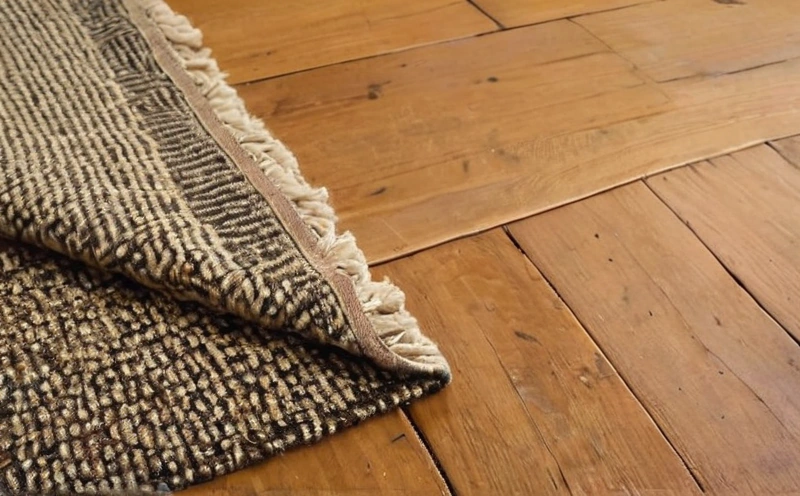
Run a flat palm across a wool rug: in one direction the pile lies smooth and the colour reads pale, in the other the pile resists the hand and the colour reads deep. Light reflecting off the fibre sides looks pale, and shaded fibre tips look dark, so a single yarn colour produces two tones.
Construction sets the lay. A hand knotted wool rug takes direction from the angle at which the weaver clipped each row of knots. A hand tufted rug takes direction from the tufting gun, and a machine woven rug from the loom, which is why machine woven pile direction is uniform across the full width and hand knotted pile direction wanders slightly from row to row.
Place a new wool rug so the pile leans toward the main viewpoint, usually the seating rather than the door, because pile leaning toward the viewer reads richer in colour and hides footprints. Vacuum along the lay on regular passes. Reserve one against the lay pass for the deep clean every 3 to 6 months, since working against the lay opens the base of the pile and releases trapped grit.
When is shading on a wool rug a fault, and when is shading normal?
Three separate effects get called shading on a wool rug. Pile reversal is a permanent change in fibre direction and counts as a characteristic, not a fault. Abrash is a horizontal band from a separate dye lot in a hand knotted rug. Corn rowing is crushing along a traffic path and counts as a genuine fault.
| Effect | What the effect looks like | Cause | Reversible | Treated by the trade as |
|---|---|---|---|---|
| Pile reversal, also called watermarking | Irregular pale patch with a soft border that changes tone as the viewer moves | Groups of tufts permanently lean the opposite way to the surrounding pile | No, no cleaning method restores the original lay | A characteristic of dense cut pile, most common in plain colours |
| Abrash | Narrow horizontal bands of slightly different colour across the full rug width | Separate hand dye lots of yarn used through one weaving run | Not applicable, the colour difference is in the yarn | A mark of hand dyeing that adds value |
| Corn rowing | Long parallel ridges following the walking route across the rug | Pile crushed in lines on a low density rug walked in the same track daily | Partly, by grooming and rotation before the crush sets | A genuine fault, usually traced to pile density |
Pile reversal has no reliable prevention and no reliable cure, which is the reason carpet and rug manufacturers exclude the effect from warranties. A wool rug showing pile reversal has lost no fibre and no strength: the tufts point a different way, and the eye reads the change as a stain that will not lift.
Which wool rug pile density resists crushing in a traffic path?
Wool rug pile density decides how long the pile stands upright under a traffic path. A hand knotted rug at 120,000 knots per square metre keeps the tufts vertical for years, while a loose hand tufted rug at 40,000 tufts per square metre corn rows within months. Pile weight matters as much as knot count.
| Construction | Typical density | Pile height | Pile weight | How the pile is held |
|---|---|---|---|---|
| Hand knotted wool, fine | 120,000 to 250,000 knots per square metre | 5 to 8 mm | 1,800 to 2,600 g per square metre | Each knot tied round the warp, no adhesive anywhere in the rug |
| Hand knotted wool, coarse | 60,000 to 120,000 knots per square metre | 8 to 14 mm | 1,500 to 2,200 g per square metre | Each knot tied round the warp, no adhesive anywhere in the rug |
| Hand tufted wool | 40,000 to 90,000 tufts per square metre | 10 to 16 mm | 1,600 to 3,000 g per square metre | Latex adhesive plus a glued scrim backing |
| Machine woven wool blend | 250,000 to 500,000 points per square metre | 6 to 10 mm | 900 to 1,600 g per square metre | Woven into the ground weave on the loom, no adhesive |
Pile height and density trade against each other. A short dense pile at 6 millimetres and 200,000 knots per square metre bends over a short lever arm and springs back from a footprint. A long loose pile at 16 millimetres and 40,000 tufts per square metre has a long lever arm and few neighbours to lean on, so the tuft stays flat once crushed.
Latex backing on a hand tufted rug is a second consideration. Latex hardens and powders after roughly 8 to 15 years in a dry heated room, and a hand tufted rug that sheds grey dust from the underside has reached the end of its backing life rather than the end of its pile life.
How often should a wool rug be rotated 180 degrees?
Rotate a wool rug 180 degrees every 6 months in a room with even daylight, and every 3 months in a room with one strong window, because ultraviolet exposure fades the exposed half first. A wool rug under a dining table needs rotation every 3 months whatever the light, since chairs concentrate wear in a narrow ring.
Dye choice sets the fade rate. Wool rug yarn rated 5 on the blue wool scale of BS EN ISO 105-B02 needs roughly twice the light exposure of yarn rated 4 to fade by the same visible amount, because each step on the 1 to 8 scale roughly doubles the exposure required. Vegetable dyed wool commonly tests lower than 4, which is why an antique rug in a south facing room shifts colour in a few summers.
Write the rotation date on a paper label pinned to the underside of the wool rug. Six months exceeds what anybody recalls accurately, and the benefit of rotation depends entirely on turning the rug before a wear pattern becomes visible.
How do you raise a furniture dent in a wool rug?
Place one ice cube in each dent in a wool rug and leave the cube 30 to 60 minutes until melted. Wool swells 16 percent in diameter as the fibre takes up cold water, and the crimp pushes the tuft upright. Blot the surplus, lift the tufts against the lay, then dry 2 hours under a fan.
Lift the tufts with the edge of a spoon or a stiff plastic brush while the wool is still damp, working against the lay so the brush reaches the base of the tuft. Wool recovers from compression that has lasted months, provided the fibre has not been held flat and dry for years, which sets the crimp into the new shape.
For an older dent, hold a steam iron 15 centimetres above the wool, never touching, steam for 10 seconds per dent, then brush the tufts upright immediately. Direct iron contact does not melt wool, but contact flattens and glazes the fibre tips permanently, so the 15 centimetre gap is the whole method.
How do you stop furniture legs denting a wool rug again?
A sofa leg with a 4 square centimetre foot carrying 40 kilograms loads wool pile at 10 kilograms per square centimetre. Clear plastic cups spread the same 40 kilograms across 20 square centimetres and drop the load to 2 kilograms per square centimetre, a cut of 80 percent.
Move heavy furniture 3 centimetres at every rotation so the pile rests in a slightly different position each cycle and no single row of tufts carries the load continuously. Castors are worse than flat feet on a wool rug, because a castor concentrates the same weight onto a contact patch under 1 square centimetre and rolls the crush along a line.
Wool responds to moisture identically in a rug and in a seat cover, so the 30 degree Celsius water limit and the pH 4.5 to 8.0 window in the note on wool upholstery care apply to rug cleaning without change.